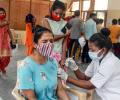
A June 11 survey by cLocalCircles across 299 districts puts overall vaccine hesitancy levels at 18 per cent, with 11 per cent of the respondents saying they were not convinced if the currently available vaccines would protect them against the new strains; and 5 per cent said they do not plan to take the vaccine at all.
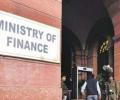
The finance ministry on Wednesday reimposed expenditure curbs on ministries and government departments for July-September quarter. There will be no spending restrictions on the ministries of health, rural development, agriculture, MSME (micro, small and medium enterprises) and railways as part of a two-pronged strategy. "The existing guidelines for expenditure control have been reviewed. "Keeping in view the evolving situation arising out of Covid-19 and anticipated cash position of the government, it is felt essential to regulate Quarterly Expenditure Plan (QEP)/Monthly Expenditure Plan (MEP) of specific ministries/departments for July-September, 2021," the Department of Economic Affairs in the finance ministry said in a notification.

Direct economic stimulus measures such as tax cuts for individuals and industry would have helped to prop up the Indian economy which was hit hard by the lockdowns across several states in India, say economists and corporate leaders. While the measures announced on Monday are focussed more on the supply side, these steps would take a lot of time to move the needle for the economy.

865 million Indian adults require vaccination.

Easier dilution norms for mega initial public offerings (IPOs) have come into effect. Companies with post-listing market capitalisation (m-cap) of more than Rs 1 trillion will not be required to dilute a minimum of 10 per cent. The move to relax dilution norms is seen as a precursor to Life Insurance Corporation's IPO. The central government has said companies with an m-cap exceeding Rs 1 trillion will have to dilute Rs 5,000 crore and at least 5 per cent of their m-cap. Experts said the earlier framework discouraged large companies from listing since they were forced to offload a large volume of shares during the time of their IPO.

A number of listed companies are not to be found on their registered address. The stock exchange has also been unable to contact them through other means. These 50 companies had been suspended for violations for more than six months. The BSE had reached out to them with show cause notices in December 2020.

The Goods and Services Tax (GST) Council, chaired by Union Finance Minister Nirmala Sitharaman, will likely consider on Saturday a GST rate cut for Covid-19 relief essentials and drugs for treating the black fungus disease and might leave the vaccines untouched. The meeting is being held following a report submitted by a Group of Ministers (GoM) to the GST Council on Monday. The GoM, set up by the Council on May 28, was mandated to look at tax exemption and concessions on various Covid items including vaccines, drugs, and equipment.

According to medical practitioners, the treatment is especially useful in controlling disease among those who have not received the vaccine or got only one shot and also the high-risk contacts of a patient.
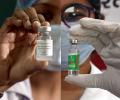
The study by a group of doctors showed that after two shots of the vaccines, 98 per cent recipients of Covishield showed antibody response, while the same was 80 per cent among Covaxin recipients. Sohini Das and Ruchika Chitravanshi report.

'I would recommend two parts to fiscal support. One, support the lower end of the society by direct intervention through ways such as direct benefit cash transfer. Second, give fiscal support to the stressed sectors in line with the Rs 3-lakh crore (Rs 3 trillion) emergency credit line guarantee norms'

States should ensure a weekly positivity rate of less than 5 per cent, vaccination coverage of at least 70 per cent among the vulnerable section, and community ownership of Covid-appropriate behaviour, reports Ruchika Chitravanshi.
India's economy is unlikely to see double-digit growth and may grow between 8 per cent and 9 per cent this fiscal year (2021-22, or FY22), against the estimated 11.5 per cent, according to leading economists and rating agencies. The downward revision of growth projections to as low as 10 per cent is mostly on account of stringency in restrictions by states, relatively slow vaccination pace, and the possibility of a third wave of the pandemic. However, they say the impact will not be as severe as the first wave, and expect the first quarter to see positive growth.
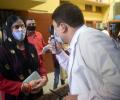
Hardly anyone wears a mask and most brush off concerns over a pandemic. It is not just scepticism over the existence of the pandemic. A common refrain across villages is the fear of vaccines, reports Ruchika Chitravanshi.

The two central premier investigative agencies - Central Bureau of Investigation and Enforcement Directorate - have asked their officials to focus more on digital evidence, e-forums and social media to crack down on offenders. These are a crucial part of prosecution amid the second wave of the pandemic. The Income Tax Department is going full throttle on data analytics to issue notices in time-bound cases. Further, sleuths have been given electronic devices including laptops with secure connections, which keep data encrypted and inaccessible.

'If you approached it with that level of aggression in 100 days, you would have vaccinated more than half of your country.' 'On a mass scale you will be able to eliminate that wave.'

The finance ministry has asked the tax department to impose hefty penalties on those hospitals found with unaccounted cash, and such entities could be booked under anti-money laundering laws and prosecuted, reports Shrimi Choudhary.
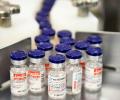
India is expecting 156 million doses of the vaccine from August to September, reports Ruchika Chitravanshi.

If that outcome were to happen, the Modi government would be responsible for presiding over a self-inflicted national catastrophe.
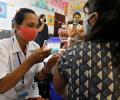
Delhi, which has been one of the worst affected states, accounted for less than two per cent of total vaccinations in the 18-44 age-group.
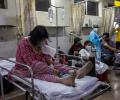
But the numbers have continued to rise in 23 states including Bihar, Goa, Andhra Pradesh, Tamil Nadu and Kerala.
 © 2025 Rediff.com - Investor Information - Advertise with us - Disclaimer - Privacy Policy - Sitemap - Feedback - About us - Terms of use - Grievances